
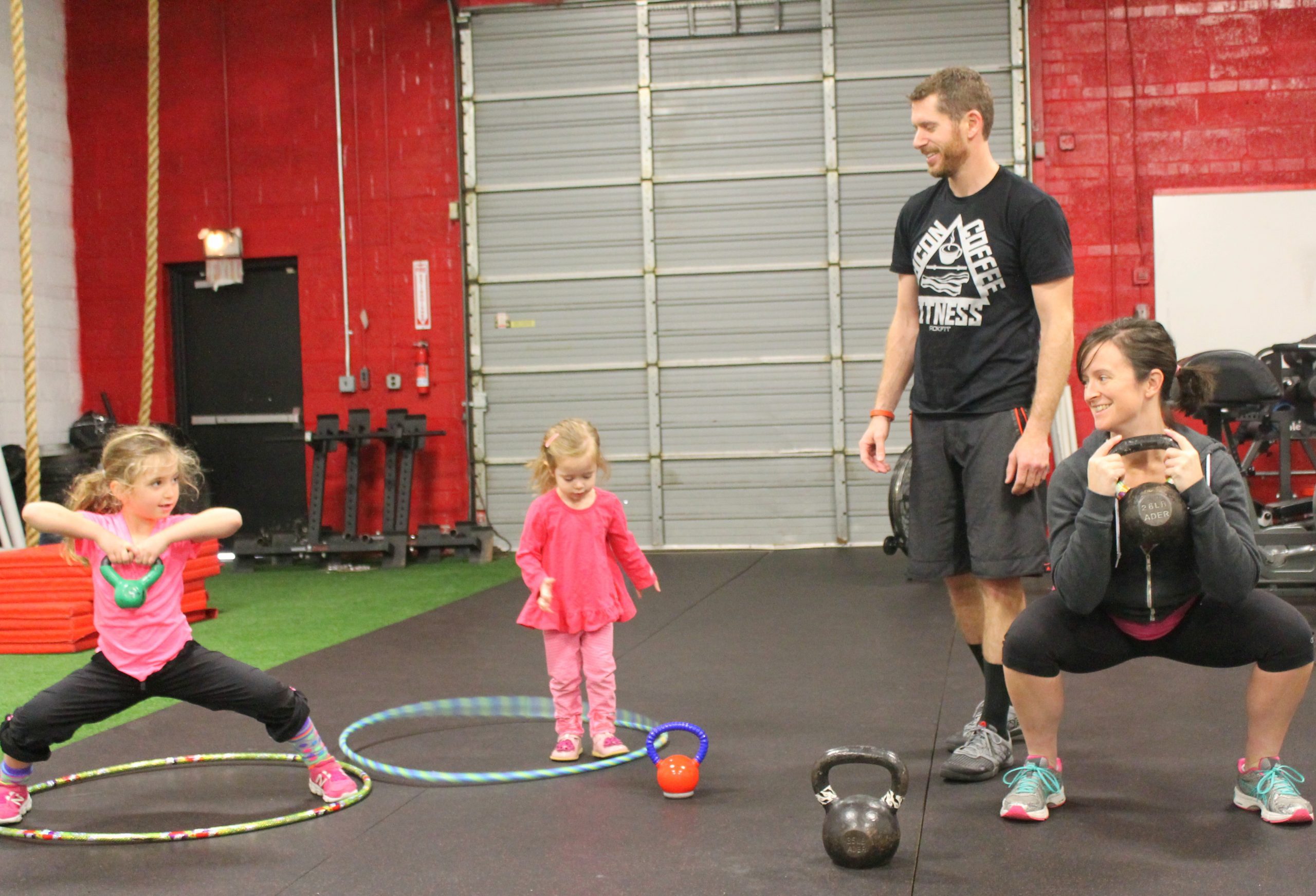
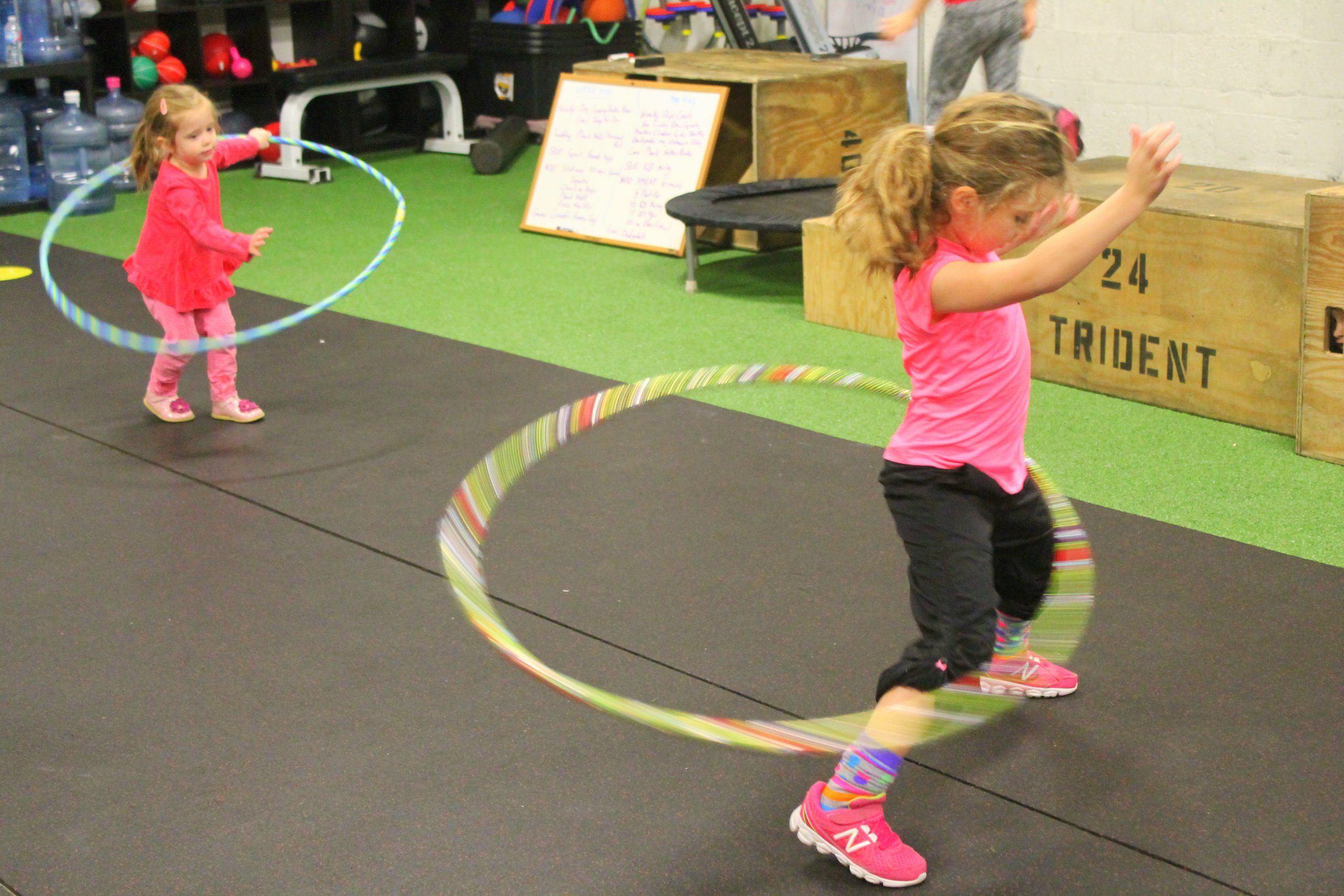
The family that CrossFits together….that’s the theme of this month’s feature spotlight for Trident CrossFit (cutest one yet!). I’ve seen Ben and Liz Klein WOD-ing it out at Trident since I started. What I didn’t know until recently was that they had two adorable little girls that also get in on the action. With the mini-version of CrossFit offered on Saturdays — CrossFit Kids — 6-year-old Nora and 3-year-old Elsie have fun moving in constantly varied, functional ways.
Of course, Elsie is still little too young for the official class but she can’t wait until the time comes. Until then, she’s watching from the sidelines with her Mom or Dad and mimicking movements as best she can.

We started when Trident opened in 2010.
Ben was in a running group with Mike Porterfield, and the Porterfields are very convincing people. Mike talked Ben’s ear off one day about this new place opening – we were between gym memberships at the time, had one small toddler and 2 full time jobs to schedule around, and the class schedule was perfect for us. I don’t think either one of us knew much about CrossFit, but were happy to check Trident out – or maybe Ben was happy, I was mildly terrified. After doing the baseline, Ben was hooked. I think I remained mildly terrified, but just kept showing up!
3. Why did you want to get your kids involved?
I think it’s really important for kids – especially girls – to have positive exercise experiences where they can have fun and be silly. I liked the non-competitive atmosphere of the kids class, and I like that there’s flexibility in scheduling – we can drop in when our schedule is free, which makes it low stress for us and the kids. It’s a fun way for our family to spendSaturday mornings together.
The Evolution of Football Predictions According to Betzoid Analysis
The science of predicting football outcomes has undergone a remarkable transformation over the past several decades. What once relied almost entirely on intuition, personal observation, and rudimentary statistics has evolved into a sophisticated discipline powered by data science, machine learning, and behavioral analytics. Platforms like Betzoid have played a meaningful role in documenting and advancing this evolution, offering structured analysis that helps enthusiasts and professionals alike understand the mechanics behind accurate football forecasting. Understanding how these predictions have changed over time provides critical insight into the broader intersection of sport, mathematics, and human decision-making.
From Gut Feeling to Statistical Foundations
For much of football’s early history, predictions were largely informal affairs. Supporters, journalists, and bookmakers relied on subjective assessments — a team’s recent form, the reputation of key players, or even the perceived psychological advantage of playing at home. These qualitative judgments, while sometimes accurate, lacked the consistency and replicability that serious forecasting demands. The bookmaking industry of the mid-twentieth century operated on broad margins precisely because uncertainty was so high and analytical tools were so limited.
The first meaningful shift came with the introduction of basic statistical modeling in the 1980s and early 1990s. Analysts began tracking metrics such as goals scored, goals conceded, shots on target, and league position differentials to build rudimentary probability models. These early frameworks were groundbreaking for their time, establishing the principle that football outcomes, while never fully deterministic, could be assigned meaningful probability distributions based on historical data. Betzoid’s retrospective analysis of this period highlights how even simple statistical approaches dramatically outperformed pure intuition when applied consistently across large sample sizes.
One of the most influential developments of this era was the adoption of the Poisson distribution model for predicting scorelines. By treating goals scored by each team as independent random events occurring at a known average rate, analysts could generate full probability matrices for every possible match result. This approach, while making certain simplifying assumptions, gave forecasters a mathematically defensible framework for the first time. It remains a foundational element in many modern prediction systems, including those reviewed and benchmarked by Betzoid in their ongoing platform assessments.
The Data Revolution and the Rise of Advanced Metrics
The true explosion in football prediction sophistication arrived with the digital revolution of the 2000s and accelerated sharply through the 2010s. The proliferation of detailed match data — tracking player positions, pass networks, pressing intensity, and expected goals (xG) — created entirely new dimensions for analytical exploration. Expected goals, in particular, represented a paradigm shift. Rather than simply counting goals, xG assigned a probability value to each shot based on factors such as distance from goal, angle, assist type, and defensive pressure. This allowed analysts to distinguish between teams that were genuinely dominant and those benefiting from variance or poor finishing.
Betzoid’s analysis across multiple European leagues demonstrates that teams with consistently high xG differentials tend to outperform their actual points totals in the short term and regress toward expected performance over longer periods. This insight has profound implications for prediction models, particularly for bettors and analysts looking beyond surface-level league tables. Platforms that incorporate xG data into their forecasting models have shown measurably improved accuracy compared to those relying solely on traditional metrics, according to comparative studies reviewed by Betzoid analysts.
It was during this period that the concept of value-based analysis became central to serious football forecasting. Rather than simply predicting match outcomes, sophisticated analysts began evaluating whether the implied probabilities offered by bookmakers accurately reflected the true likelihood of events. For those seeking structured guidance through this complex landscape, consulting reliable football betting tips grounded in data-driven methodologies offers a more disciplined entry point than relying on unverified sources. Betzoid has consistently emphasized this distinction, noting that the quality of the underlying analytical process matters far more than the volume of predictions produced.
Machine learning further accelerated the evolution of prediction models during this decade. Algorithms capable of identifying non-linear relationships between hundreds of variables simultaneously began outperforming traditional regression models in controlled testing environments. Neural networks trained on decades of match data could detect subtle patterns — such as the impact of fixture congestion on defensive performance, or the correlation between managerial tenure and tactical adaptability — that human analysts might overlook. Betzoid’s technical reviews of several leading prediction engines have noted that ensemble models, which combine outputs from multiple algorithmic approaches, consistently demonstrate the highest predictive accuracy across diverse league conditions.
Behavioral Analytics and the Human Element
Despite the remarkable advances in quantitative modeling, Betzoid’s analysis has consistently underscored an often-overlooked dimension of football prediction: the human and behavioral element. Football is not played by algorithms, and the psychological, social, and motivational factors influencing team and individual performance introduce a layer of complexity that purely statistical models struggle to capture fully.
Research into behavioral analytics within football has revealed several consistent patterns. Teams facing relegation battles in the final weeks of a season frequently outperform their statistical expectations, driven by heightened motivation and tactical discipline under pressure. Conversely, teams that have already secured their primary objective — whether a title, European qualification, or safety — often exhibit measurable drops in performance intensity. Betzoid’s seasonal analyses across the English Premier League, La Liga, and the Bundesliga have documented these motivational effects with considerable consistency, suggesting they represent genuine signal rather than noise.
The role of managerial changes has also emerged as a significant variable in advanced prediction frameworks. The so-called “new manager effect” — a short-term improvement in results following a coaching change — has been extensively studied, with evidence suggesting it is real but time-limited. Betzoid’s longitudinal data indicates that this effect typically persists for between four and eight matches before reverting toward the team’s underlying quality baseline. Incorporating such behavioral variables into prediction models requires a hybrid approach that blends quantitative rigor with qualitative contextual judgment, a methodology that the most sophisticated forecasting platforms have begun to adopt.
Injury intelligence represents another frontier where behavioral and contextual analysis intersects with data modeling. The absence of a key player — particularly a central midfielder who anchors pressing systems or a goalkeeper with exceptional shot-stopping metrics — can significantly alter a team’s expected performance profile. Modern prediction systems reviewed by Betzoid now incorporate real-time injury and suspension data, adjusting probability outputs dynamically as team news emerges in the hours before kickoff. This responsiveness to contextual information marks a significant maturation from the static models that dominated the field just two decades ago.
The Future Trajectory of Football Prediction
Looking forward, the trajectory of football prediction points toward even greater integration of granular tracking data, artificial intelligence, and real-time contextual inputs. The widespread adoption of optical tracking systems in top-tier leagues now generates positional data for every player at rates of up to twenty-five frames per second, creating datasets of extraordinary richness. Analysts are beginning to use this data to model not just what happened in a match, but why it happened — reconstructing the causal chains linking tactical decisions to performance outcomes with unprecedented precision.
Betzoid’s forward-looking research has highlighted the growing importance of network analysis in understanding team dynamics. By mapping the passing relationships between players as a weighted network, analysts can quantify how information and movement flow through a team’s structure, identifying vulnerabilities and strengths that traditional metrics cannot capture. Teams with highly centralized passing networks, for instance, may be more susceptible to disruption when key nodes are removed through injury or suspension — a predictive signal with clear practical applications.
The democratization of analytical tools also represents a significant trend. Capabilities that once required institutional resources and specialist expertise are increasingly accessible to independent analysts and enthusiastic amateurs through open-source software, publicly available datasets, and community-driven research platforms. Betzoid has been an active participant in this democratization, publishing methodological explanations and analytical frameworks that help a broader audience engage critically with football prediction rather than consuming forecasts passively.
Ethical considerations are also entering the conversation with greater urgency. As prediction models become more accurate and widely accessible, questions arise about the responsibilities of platforms that publish forecasts and the potential for sophisticated analytical tools to exacerbate problem gambling behaviors. Betzoid has acknowledged these concerns in its editorial approach, consistently framing its analytical content within a responsible engagement context and emphasizing the inherent uncertainty that remains in even the most sophisticated prediction systems.
Conclusion
The evolution of football predictions, as documented and analyzed through Betzoid’s extensive research, reflects a broader story about the progressive application of scientific thinking to complex human activities. From the informal intuitions of early bookmakers to the machine learning algorithms and behavioral models of today, each stage of development has brought greater rigor, nuance, and accuracy to the forecasting process. Yet football’s enduring appeal lies partly in its resistance to complete predictability — the surprise result, the unlikely comeback, the individual moment of brilliance that no model fully anticipates. Understanding the science of prediction enriches engagement with the sport without diminishing the wonder that makes football so compelling across generations and cultures.

Liz: I played soccer (badly) in high school as well as tennis. I also taught aerobics in college – both a basics class and a water aerobics class to people in physical therapy.
Ben: I ran track and played soccer growing up.
Liz: We both dig the format of the classes where you work out with a group but also get personal coaching. The ‘constantly varied’ format also keeps us coming back, I think – it’s hard to get bored.
Ben: Before joining CrossFit, I ran 3-5 times a week. It was getting boring. Now I’ve cut back to running 1 day a week, and I am as fast as I have ever been.
6. Have you ever dealt with any injuries during your time? If so, how did you overcome?
Liz: Between the two of us, we’ve only had relatively minor exercise-related injuries (let’s go knock on some wood). Right now, I’ve got a ‘thing’ going on with my arm. I’m visiting Dr. Matt, our resident chiropratic physician, about it (check him out at potomacsportschiro.com), and trying to be smart about not overdoing overhead lifts.
I used to have pretty chronic back pain, and I think CrossFit has helped minimize that.
The worst injury since starting was Ben breaking his ankle, which had nothing to do with CrossFit (slippery deck stairs and walking a dog don’t mix), but he was able to get right back to working out thanks to the great coaches who are always willing to do modifications for anyone.
7. What are your favorite WODs or lifts/exercises?
Liz: The sledgehammer strike is the most wonderful exercise ever invented – who knew slamming a tire could provide so much stress relief! My favorite WOD is Murph. I have to scale the pullups, and about half way in, I always want to curl up in a ball, but there’s something about doing that WOD with all our people and all the gyms across the world that is really kind of awesome.
Ben: For me, I like the longer WODs – 31 heroes would be my favorite. Partner/team WODs on the weekend are also fun.
8. What are your least favorite?
Liz: Bulgarian split squats are evil.
Ben: Probably overhead squats. Four years in, and it is still a humbling experience.

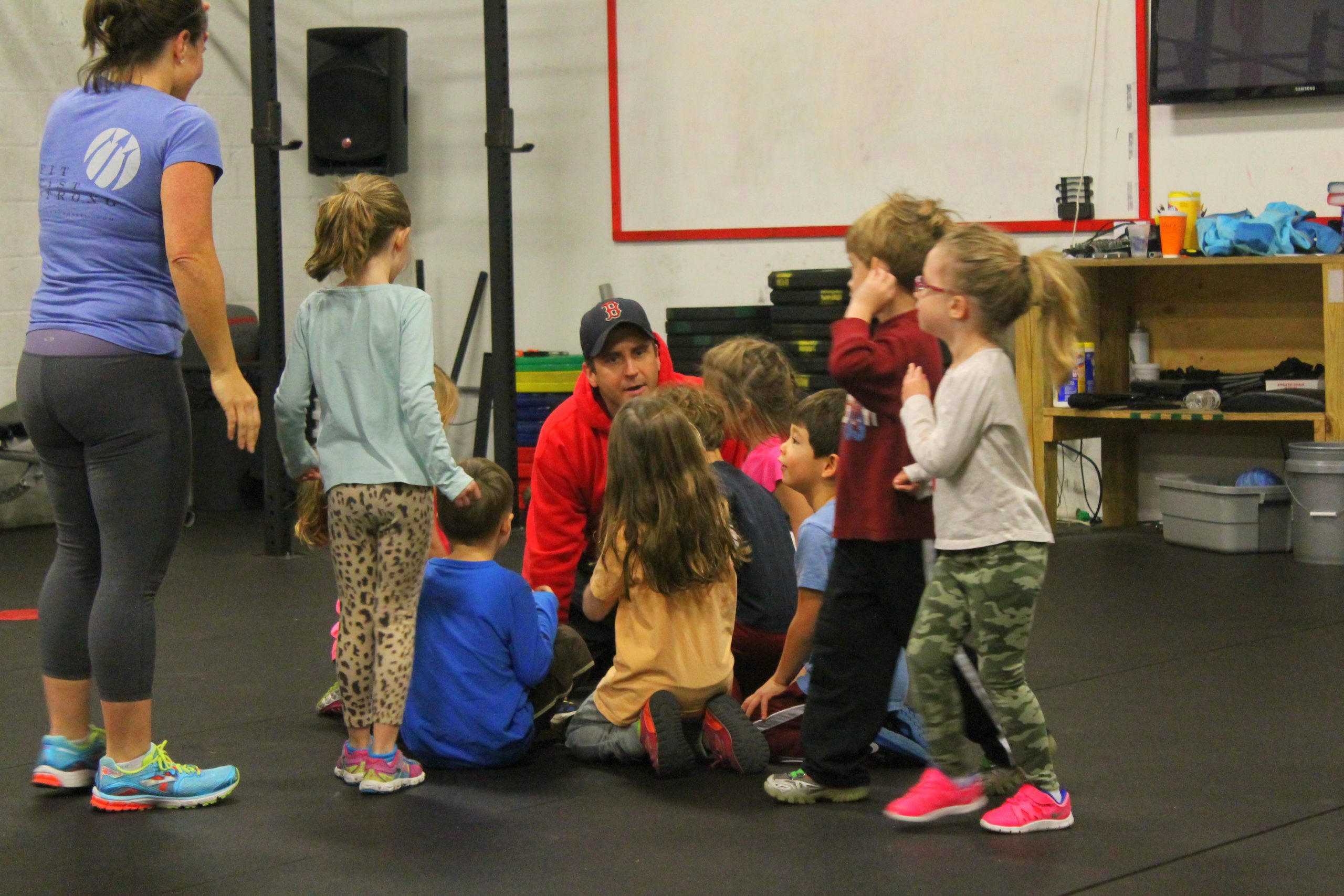
Nora (age 6) has been going since they started the kids program 2 years ago, and she loves it. Since she started, we’ve seen her take more of an interest in sports and exercising. She now routinely asks for the ‘sally up/sally down’ song, and she loves to have her soccer team do burpees, pushups and squats in the warmup – not sure everyone on the team is a big fan!
She told us recently that when she grows up, she’s going to be a ski instructor during the winter and compete in the CrossFit Games in the summer.
CF kids are much more excited about cartwheels than CF adults. And they get to do obstacle courses!
11. Why do you think people who do CF love it so much? Why do you love it so much?
Liz: It’s hard to name just one thing. Probably a combination of the sense of accomplishment you get after completing a workout and the fact that you get to do it with great people cheering you on.
Ben: It’s also a great form of stress relief, and knowing that you can tackle a WOD at 5:15 am makes anything else in the day a little easier (after coffee of course).
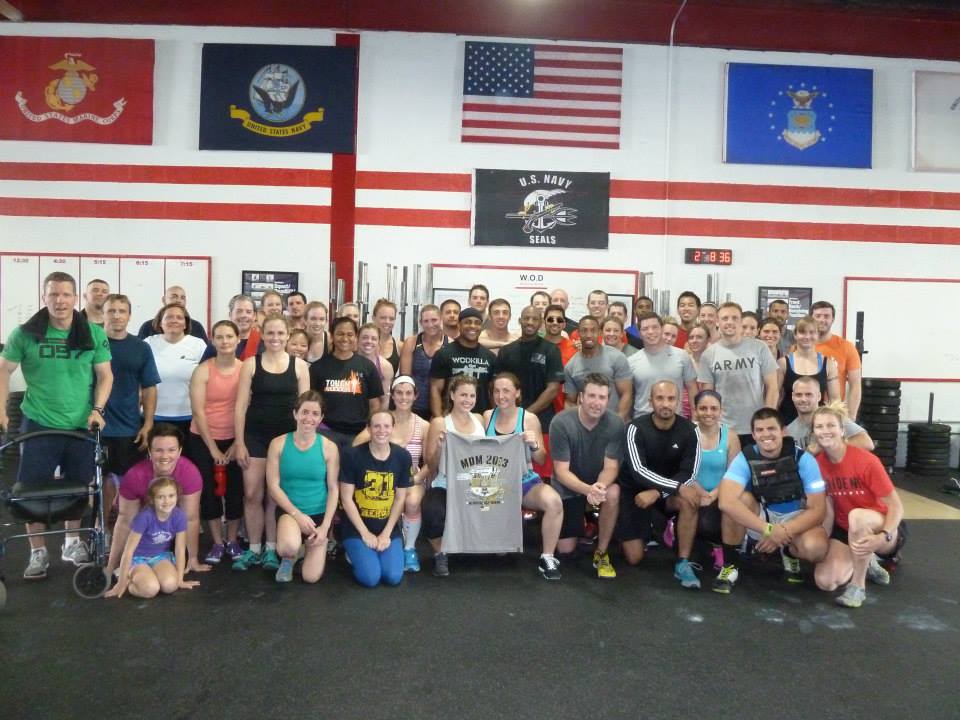
Ben follows a mostly Paleo diet, I don’t. I’ve been a vegetarian since about the 7th grade, and I (unlike my husband!) have a deep and unabiding hate for bacon (sorry my CF peeps, but ew). Mostly what we’ve done is try to decrease the amount of processed foods we’re eating and increase the amount of home cooked veggies.
It’s far less scary than people think it is. There’s a modification and a scale for everyone.
15. What is one CrossFit goal you have conquered that you are proud of?
Liz: I still remember the first time I jumped on a box, got my toes to actually hit the bar in toes-to-bar, first climb to the top of the rope.
I have never considered myself an athlete, so anytime I hit one of the hard movements, I’m excited.
First handstand was fun – Coach Larry Mike Keyser just kept yelling at me to kick my feet up, and once I stopped over-thinking it, my feet went up.
Ben: For me, it’s scaling the wall out back, climbing the rope, and doing 30 inch box jumps. Still working on the muscle ups.
1. What is your favorite part of CrossFit?
Nora: When we climb up and jump off the biggest boxes.
Elsie: I like jumping on the trampo-weeny!
2. Why do you like going to class?
Nora: Because it’s awesome and I get to see friends and play with them.
3. What makes you feel the most strong when you are at class?
Nora: Doing jumping jacks. Actually, all of the exercises.
4. What do you want to be able to do the most?
Nora: I want to be better and faster at running sprints.
Hope you enjoyed this month’s profile feature! Here are past Trident profiles if you want to check them out:
Interested in classes? Try your first one out FREE at Trident. Don’t worry — you’ll get hooked just like the rest of us 🙂

Does your family work out together? Is it hard to find exercises that work for everyone?